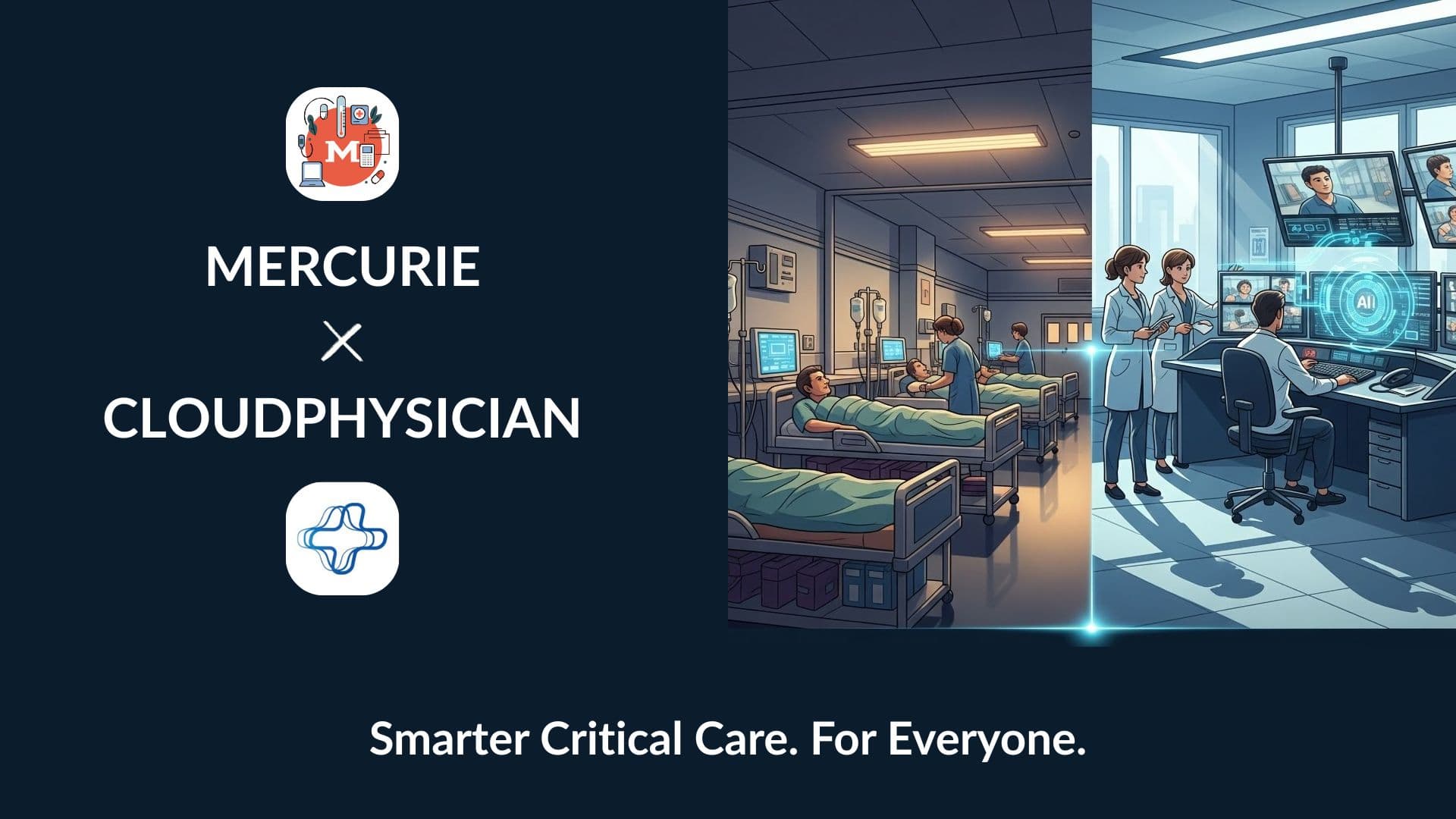
Cloudphysician Joins Mercurie Pilot
To boost operational efficiency in critical care management.
Imagine a loved one suddenly falling gravely ill and needing constant, specialized medical attention to survive. This is the world of critical care, a field at the forefront of saving lives, yet one that faces immense pressures. This blog post will demystify what critical care is, explore the significant challenges it confronts in the nation, and highlight the innovative solutions paving the way for a more secure future.
Introduction: What is an ICU?#
An Intensive Care Unit (ICU), sometimes called a Critical Care Unit (CCU), is a specialized ward in a hospital for people with life-threatening illnesses or injuries [1]. Think of it as a place of constant, high-level medical care and monitoring for the most vulnerable patients.
Patients in an ICU might be recovering from major surgery, have had a severe accident, a heart attack, a stroke, or be battling a serious infection like sepsis or severe pneumonia. Many are unable to breathe on their own and require the support of a ventilator, a machine that does the work for their lungs.
In the ICU, a dedicated team of specially trained doctors, nurses, and other healthcare professionals provides round-the-clock care. There is typically one nurse for every one or two patients, allowing for close observation. This environment is filled with sophisticated equipment that monitors vital signs like heart rate, blood pressure, and oxygen levels in real-time, helping the medical team make immediate, life-saving decisions.
Challenges: A System Under Strain#
Despite its crucial role, critical care in India is facing a multitude of challenges that impact patient outcomes and access to care.
The Numbers Game: A Shortage of Beds and Specialists
A significant hurdle is the sheer lack of resources. For a population of over 1.4 billion, India has a stark shortage of trained ICU doctors, known as intensivists. There were an estimated 95,000 ICU beds in India as of 2020 [2]. Some reports suggest a threefold increase since then, giving a current estimate of 300,000 [3][4][5]. But only 18,000 critical care providers, of which 6,000 are estimated to be trained intensivists, are currently registered with Indian Society of Critical Care Medicine (ISCCM) [6].
To put these numbers into perspective: assuming an optimistic scenario where ICU resources are utilized uniformly over time, and that on average a patient stays in the ICU for 3.6 days during their treatment [7], this would mean a single bed can accomodate nearly 100 stays in a year on average. 21 beds can, therefore, accomodate 2,100 admits in a year, or 2 people in a population of 100. Or looking at it another way, there are enough ICU beds to accomodate 2 stays of 3.6 days each for a person with a lifespan of 100 years. And during these 2 stays, an intensivist will be able to check on them for 10 minutes a day (every day an intensivist has to check 50 beds during their 8 hour rounds, allowing them 10 minutes per bed).
This scarcity is compounded by an uneven distribution of ICU facilities. The majority of ICU beds (around 62%) are concentrated in the private sector, making them unaffordable for a large portion of the population. Geographically, urban centers are far better equipped than rural areas, where more than 65% of India's population resides but where ICU care is poor or absent at the district level, as is access to speciality care such as ventilation. This disparity means that your chances of survival in a critical situation can heavily depend on where you live and what you can afford.
Estimated ICU beds per 100k population (2020)
Lack of Comprehensive Data
A fundamental problem that hinders progress is the absence of a centralized system for tracking the number of ICUs, their staffing levels, and patient outcomes [8]. This lack of authentic, nationwide data makes it incredibly difficult for policymakers to accurately assess needs, plan for the future, and enforce uniform standards of care.
High Mortality Rates
A combination of these challenges contributes to concerningly high mortality rates in ICUs. Studies have found the average ICU mortality to be as high as 23.4% [9]. Sepsis, a life-threatening response to infection, is a major cause of death, with a mortality rate of 36.9%. A study by AIIMS in New Delhi during the COVID-19 pandemic revealed an ICU mortality rate of 38% [10]. These figures underscore the urgent need for improvements in the quality and accessibility of critical care.
Innovations#
In the face of these daunting challenges, technology is helping to bridge the gaps in critical care.
The Rise of Smart-ICUs
One of the most promising developments is the growth of Smart-ICU platforms. These systems use secure video and data feeds to allow intensivists to monitor and manage patients in ICUs located in remote or smaller towns from a central command center. This “hub and spoke” model helps to multiply the reach of the few available specialists, bringing expert care to underserved areas.
A Spotlight on Cloudphysician
A key player in this transformation is Cloudphysician. Founded in 2017 by Dr. Dileep Raman and Dr. Dhruv Joshi, two critical care specialists trained at the highly regarded Cleveland Clinic in the US, the company aims to make high-quality critical care accessible to everyone.

Cloudphysician partners with hospitals to convert their existing ICUs and NICUs into Smart-ICUs and Smart-NICUs. They do this using their proprietary AI SaaS platform, RADAR, which integrates with hospital equipment. High-definition PTZ cameras and real-time data flows allow a team of expert intensivists and nurses based in a central location to oversee patients 24/7 across India.
This team works in collaboration with the bedside doctors, providing them with real-time recommendations and guidance to ensure the best possible care. This approach not only provides a solution to the shortage of intensivists and specialists, but has also demonstrated a significant impact on patient outcomes. Cloudphysician reports that its smart-ICU solutions have lead to up to 40% reduction in ICU mortality rates.
Having managed over 170,000 critically ill patients across more than 300 hospitals, Cloudphysician is proving that technology can effectively bridge the critical care gap in India and beyond. Their work during the COVID-19 pandemic and in managing complex cases in remote locations has shown how technology can overcome geographical barriers to save lives [11].
Reduction in ICU mortality
(1 additional life saved per 10 patients seen)
Increase in ICU resource utilization
(More patients can be seen)
Mercurie's Role
To further streamline their workflow, Cloudphysician is enhancing its medical documentation process with the Mercurie app. When Cloudphysician's intensivists consult with bedside doctors via video call, they utilize Mercurie's AI-powered tools to directly generate patient notes from their conversations. This saves significant time. In a low-resource care environment, this efficiency is crucial, as it allows specialists to dedicate more time to patients and ultimately, save more lives.

Let's see an example of how Mercurie integrates into Cloudphysician's workflow:
Chrome Extension Integration
Mercurie is tightly integrated with Cloudphysician's RADAR platform allowing two-way data communication through generic APIs. While on a video call with the bedside doctor, the Cloudphysician intensivist can select the patient they are going to discuss, review the patient's medical summary, and start recording their conversation — all from within the Mercurie Chrome extension.
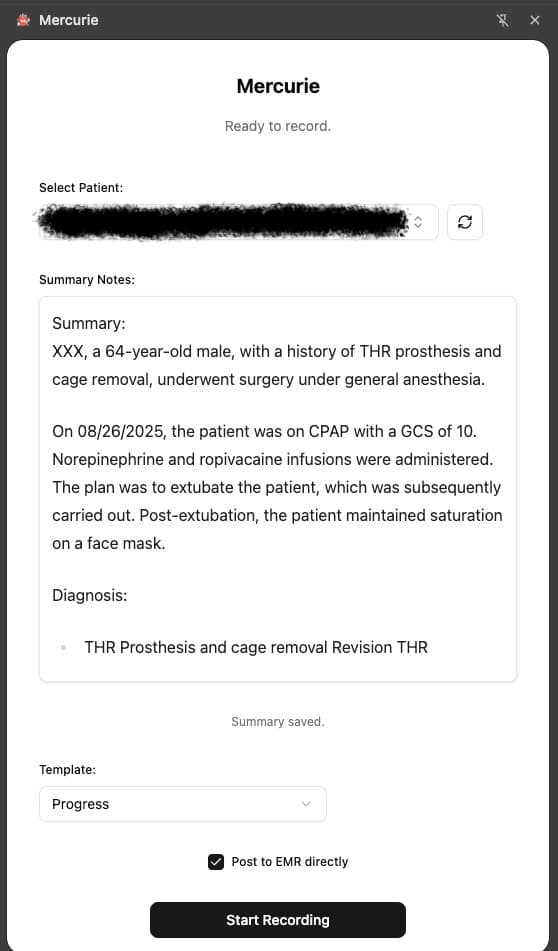
Audio Processing
At the end of the conversation the Mercurie Chrome extension sends the audio recording and the prior medical notes to Mercurie servers for transcription and summarization.
Instant Note Generation
Within seconds, medical notes are processed asynchronously in a customizable format pre-specified by the intensivists and transmitted directly to Cloudphysician's RADAR platform for an intensivist's signature.
Status
Patient underwent THR prosthesis and cage removal under general anesthesia. Currently in ICU on a ventilator, on norepinephrine, and deeply sedated with fentanyl and midazolam. He is on CPAP mode.
Diagnoses
- Post-operative state following THR prosthesis and cage removal
Todo
- Try weaning norepinephrine overnight if blood pressure is more than 110-120.
- Wait until morning for extubation; keep patient on ventilator overnight.
- Get ABG now.
- Perform CBC and RFT tomorrow morning.
- Reduce midazolam and try to wean off by morning; keep fentanyl.
Meet the Cloudphysician Team

Going Forward#
The road to strengthening critical care in India is long, but thanks to innovators like Cloudphysician and the increasing adoption of technologies like AI and telemedicine, the future looks brighter. By embracing these solutions, India can take significant strides in ensuring that every patient gets a fighting chance, no matter where they are.
To Healthcare Administrators
If you would like to upgrade your critical care management, please reach out to Cloudphysician.
If you would like to use artificial intelligence-based solutions to automate and enhance the medical documentation at your institute, please reach out to us at contact@mercurie.ai.
References11
- 1
- 2
- 3
- 4
- 5
- 6
- 7
- 8
- 9
- 10
- 11