From Conversation to Coded Record
A Leap for Global Health and Physician Well-being
In healthcare, information is everything. A patient's history, their symptoms, the medications they take — every detail is a crucial piece of a puzzle. For decades, this puzzle was assembled on paper, in files that were often hard to read, difficult to share, and nearly impossible to analyze on a large scale. The digital revolution promised to change that, but the transition has created its own challenges.
This post explores how combining the power of a robust medical records system with an intelligent AI scribe can solve these challenges, making healthcare more efficient, data-driven, and ultimately, more human.
The Foundation: Digital Notes and the EMR#
The first step in modernizing healthcare is moving from paper to digital data. An Electronic Medical Record (EMR) system is a digital version of a patient's chart. Instead of a dusty file in a cabinet, a patient's entire medical history is stored securely on a computer, accessible to authorized doctors and nurses at the click of a button.
The benefits are immense. Notes are legible, records are not easily misplaced, and multiple doctors can view a patient's chart simultaneously. For health systems, EMRs are a goldmine of data that can reveal public health trends, track disease outbreaks, and improve the quality of care for an entire population.
While many EMRs exist, one stands out for its global impact: OpenMRS. It's a free, open-source platform built by a worldwide community of volunteers and developers. Because it's free and adaptable, OpenMRS has become a lifeline for clinics and hospitals in low-resource settings, providing a world-class medical records system to those who need it most.
The Bottleneck: The Burden of Documentation#
If EMRs are so effective, why isn't every healthcare system running with perfect efficiency? The problem lies in getting high-quality information into the system. The task of typing detailed clinical notes falls on physicians, and it is a time-consuming one.
In countries like the United States, this has contributed to a crisis of physician burnout, with doctors spending hours each day on administrative tasks instead of with patients. In many developing countries, the challenge is different but just as critical. A single doctor may see dozens of patients in a day, leaving almost no time for documentation. The result is often minimal notes — or no notes at all. This means crucial details about a patient's condition and treatment plan are lost, which can compromise their future care.
This is where an AI scribe like Mercurie comes in. By simply recording the natural conversation between a doctor and a patient, Mercurie listens, transcribes, and structures the key medical information into a comprehensive clinical note. This frees the physician from the keyboard, allowing them to focus on the patient while ensuring that a rich, detailed record of the visit is captured effortlessly.
Speaking a Universal Language: The Power of Medical Coding#
Capturing comprehensive notes is a huge step forward. But to unlock the full potential of digital health, these notes need to be understandable by computer systems everywhere. Imagine one doctor writes “fever”, another writes “high temperature”, and a third uses the medical term “pyrexia.” A human knows these all mean the same thing, but a computer, on its own, does not.
This is solved by medical coding. A standardized code acts as a universal ID for a medical concept. “Fever”, no matter how it's described, gets assigned the same unique code. This makes the data interoperable — meaning it can be shared and understood by different EMR systems, hospitals, and even researchers across the globe.
This is the mission of platforms like the Open Concept Lab (OCL), which acts as a global “dictionary” for health terminology. By providing these standardized codes, OCL helps ensure that medical data is consistent and meaningful. This consistency is essential for everything from tracking medication allergies to analyzing the effectiveness of a national health program.
The Solution in Action: A Seamless Workflow#
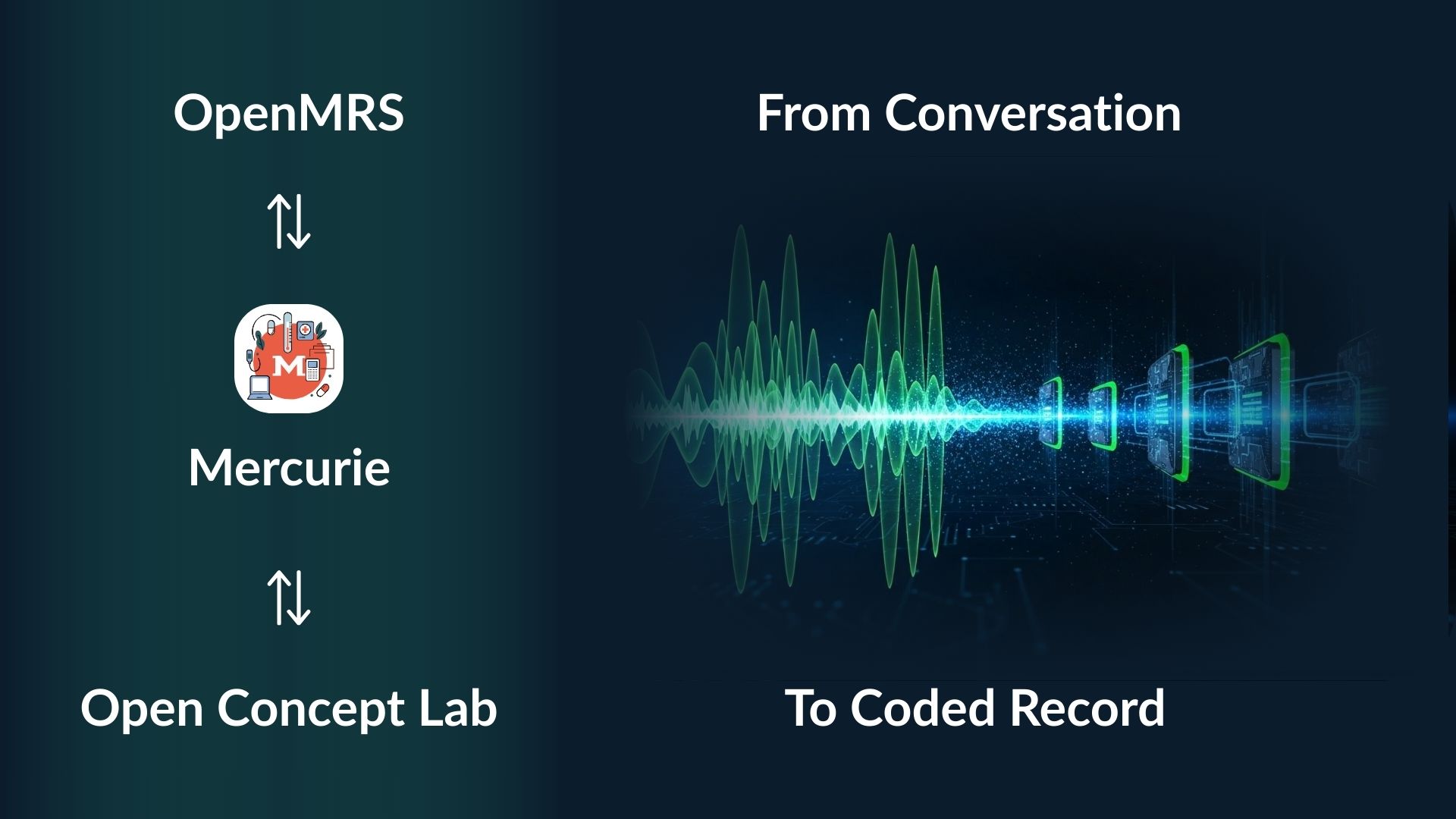
So, how do all these pieces come together? This is the magic of the Mercurie integration with Open Concept Lab and OpenMRS. The process is simple, powerful, and designed to fit directly into a clinician's workflow.
As the demo shows, the workflow is seamless:
Record and Transcribe
A physician records their patient conversation. Mercurie's AI transcribes the audio in seconds.
Extract and Structure
The AI identifies and extracts all the critical information — diagnoses, symptoms, assessments, and medication orders — and organizes it into a structured note based on a template the physician prefers.
Code Automatically
For key fields like 'Diagnosis' and 'Medication Name', Mercurie automatically queries a concept dictionary (like OCL) to find the correct international code for terms like 'Fever' or 'Paracetamol'.
Post to EMR
With a single click, the complete, structured, and coded clinical note, along with any medication orders, is sent directly into the patient's chart in OpenMRS.
The entire process of medical documentation, which once took many minutes of manual typing, is now completed in the time it takes to have a conversation. This is not just a time-saver; it's a transformation in how healthcare data is created and used.
By automating this process, we ensure that every patient record is comprehensive, accurate, and interoperable. This helps physicians make better decisions, improves patient safety, and provides health systems with the high-quality data they need to serve their communities effectively.
While this demonstration features OpenMRS, the power of this workflow is not limited to a single platform. Mercurie is designed to be EMR-agnostic and can be integrated with virtually any Electronic Medical Record system that offers an API. The middleware adapter for OpenMRS featured in the demo is free, open-source software and can be modified to support other EMRs. This means clinics and hospitals can bring the power of AI-driven, coded documentation to their existing systems, whatever they may be.
The Tangible Benefits of a Smarter Workflow#
Adopting a system that captures comprehensive, coded clinical notes has profound benefits that ripple throughout the entire healthcare ecosystem:
For Physicians
Dramatic reduction in administrative burden. This directly combats burnout and frees up valuable time for patient care.
For Patients
Better data leads to better care. Ensures continuity and reduces risk of medical errors.
For Institutions
Enables better resource management, clinical research, and quality improvement initiatives.
For Public Health
Standardized codes allow for real-time tracking of disease outbreaks and treatment effectiveness.
For Faster Insurance & Quicker Reimbursements
Standardized medical codes are the language of health insurance. By automatically capturing and coding diagnoses and procedures accurately, this system creates “clean” insurance claims that can be processed electronically with fewer errors. This dramatically reduces claim denials, minimizes the need for manual review, and significantly accelerates reimbursement cycles.
To Healthcare Administrators
If you would like to use artificial intelligence-based solutions to automate and enhance the medical documentation at your institute, please reach out to us at contact@mercurie.ai.